The gaming landscape in 2026 continues to see Warner Bros. Games sticking to a bold strategy. Despite the highly publicized collapse of Suicide Squad: Kill the Justice League, the publisher’s leadership has repeatedly championed the live-service model. In an earlier statement that still resonates through company town halls, Warner Bros Discovery executive JB Perrette explained that blockbuster AAA titles are simply too “volatile.” Their financial outcomes swing wildly, whereas a well-executed live-service game costs less to produce and can generate a steady income stream over years. From a boardroom perspective, this makes perfect sense. Yet for millions of fans who fell in love with the magic of Hogwarts Legacy, it all but guarantees that a sequel will wear the live-service label—and that brings a whirlwind of conversations to every wizarding world forum.
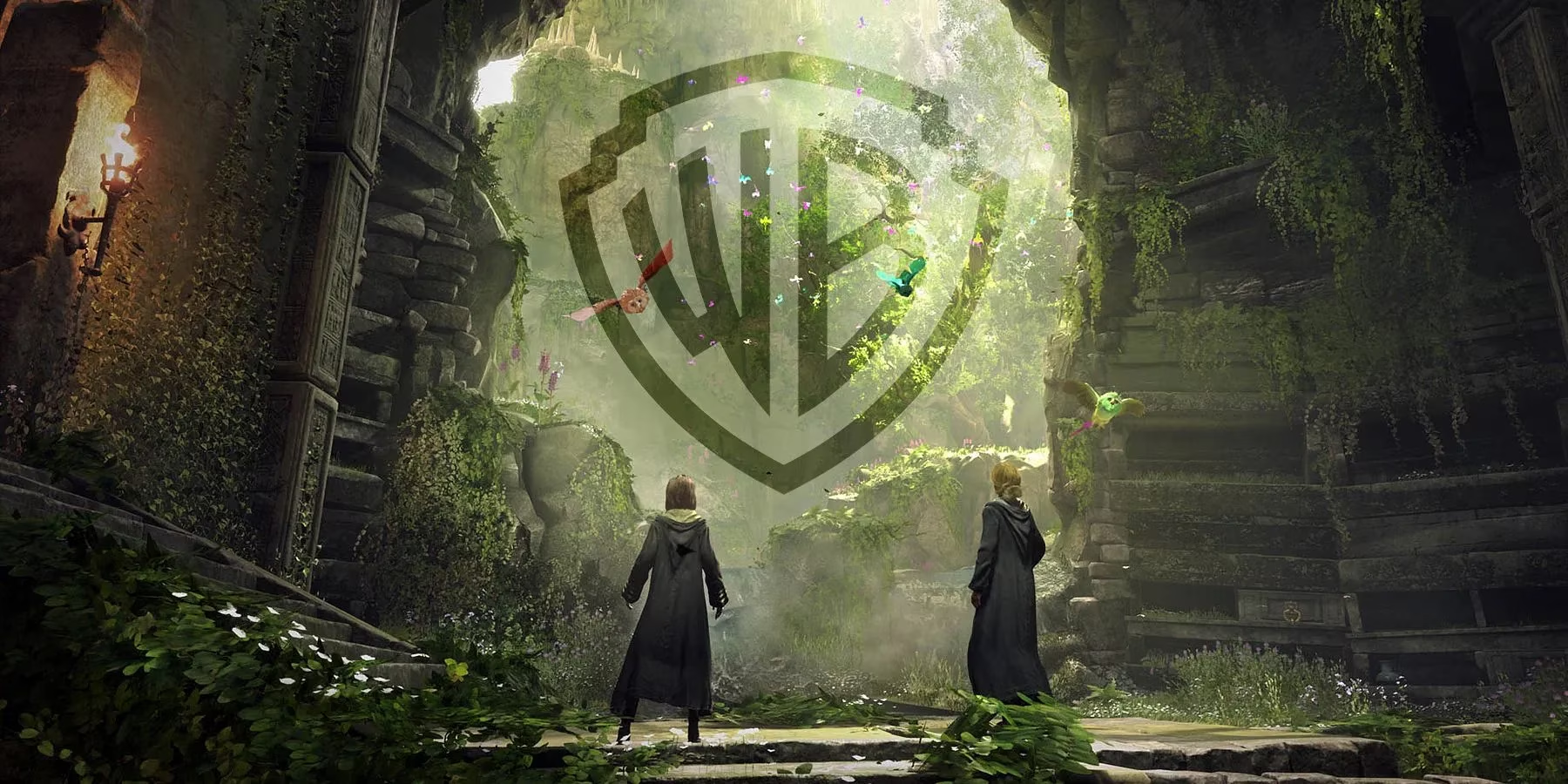
The live-service approach has earned its share of eye-rolls over the past decade, often dismissed as a greedy cash-grab wrapped in a battle pass. And sure, many titles have abused the model. But it would be unfair to paint every perpetual game with the same brush. Titles like Destiny 2, No Man’s Sky, and Path of Exile all operate as live services and have cultivated loyal communities precisely because they evolve alongside their players. When a developer listens and iterates, the game transforms from a one-time purchase into a living, breathing hobby. So, if Hogwarts Legacy 2 indeed follows this path, it won’t automatically be doomed. Instead, it will likely arrive with both glittering perks and serious pitfalls that witches and wizards will need to navigate.
The Bright Side: Extended Adventures and Constant Evolution
One of the loudest cheers a live-service sequel would earn is a dramatically longer lifespan. The original Hogwarts Legacy charmed players with its detailed recreation of Hogwarts castle, but its narrative clock was surprisingly short. According to tracking sites like HowLongToBeat, the main questline wraps up in roughly 26.5 hours. Even completionists who hunt down every demiguise statue and field guide page clock in around 66 hours before the well runs dry. After that, replaying as a different house tweaks only a handful of missions, leaving the overall experience largely unchanged. This lack of meaningful replay value made many students abandon their wands after graduation.
A live-service sequel could rewrite that ending entirely. Picture seasonal events—Yule Ball celebrations, Triwizard trials, or a new dark wizard threatening the Highlands—being added every few months. Just as Fortnite reshapes its island and Destiny 2 drops new campaigns, Hogwarts Legacy 2 could keep its castle gates open indefinitely. Players might return each season not just for fresh quests, but for evolving storylines that make the wizarding world feel genuinely alive a year or two after launch. That kind of sustained engagement would turn the game from a semester-long elective into a multi-year magical education.
Equally compelling is the model’s power to act as a catalyst for evolution. At its heart, a live-service game is never truly finished. It exists in a permanent beta state where player feedback can directly shape updates. Big-budget standalone games do receive patches, of course, but those fixes arrive slowly and rarely add new features. A live-service framework, on the other hand, allows Avalanche Software to respond nimbly. If the community begs for a Quidditch overhaul or a more robust companion system, those changes could roll out in a matter of weeks rather than being saved for a hypothetical third game. This loop of listening and adapting is why No Man’s Sky famously transformed from a disappointment into a beloved universe explorer. Under the right stewardship, Hogwarts Legacy 2 could similarly smooth its rough edges and deepen its spellbook over time.
The Dark Arts: Always-Online Demands and Monetized Cosmetics
For every lumos charm, however, there is a nox. A major drawback that makes many players grit their teeth is the always-online requirement. Live-service games live inside servers, and servers have a nasty habit of crumbling at launch. Who can forget the “Error 37” memes from Diablo III or the endless queues that plagued Final Fantasy XIV during its rebirth? If Hogwarts Legacy 2 demands a constant internet connection, aspiring witches and wizards could find themselves staring at a login screen instead of the Great Lake. For single-player fans who wanted to wander the Forbidden Forest in solitude, this forced connectivity feels like an avoidable curse.
Then there is the specter of monetization. One of the quiet triumphs of the original Hogwarts Legacy was its cosmetics system. As players collected unique robes, wand handles, scarves, and even glasses, they unlocked those appearances permanently and could mix and match them at no extra cost. It was a pure, player-friendly transmog system. If the sequel adopts a live-service framework, that goodwill is almost certain to be jinxed. Live-service games thrive on microtransactions, and cosmetic shops are their most popular storefront. It doesn’t take a seer to predict that premium robe sets, House-specific broom skins, or even seasonal wand effects will end up behind a Galleon-shaped paywall. While purely cosmetic purchases don’t affect gameplay balance, they can still fracture a community’s sense of immersion and leave a bitter aftertaste among those who remember the free generosity of the first game.
Of course, history offers both hope and warning. Suicide Squad proved that slapping a live-service label onto a franchise without soul leads to disaster. Meanwhile, games like Sea of Thieves and Warframe demonstrate that years of thoughtful, free updates can build peaceful seas of dedicated fans. For Hogwarts Legacy 2, the path forward hinges entirely on execution. If Warner Bros. and Avalanche treat Hogwarts as a temple of storytelling first and a revenue faucet second, the live-service magic could sparkle. The possibility of walking the same halls for years, watching our student grow and the world react, is tantalizing—as long as the price of admission doesn’t require endless microtransactions or a permanent internet link that shatters the illusion.
Whether the sequel is already stirring in a cauldron somewhere in development remains an official secret, but the writing on the Gryffindor common room wall is inescapable. A live-service Hogwarts Legacy 2 is more likely than not. It will come armed with the promise of longevity and communal growth, yet also lugging the baggage of server lockdowns and potential nickel-and-diming. The real question is whether the studio can handle this ancient magic with care, delivering a living Hogwarts that feels like a home rather than a storefront. Only time—and perhaps a few well-measured developer updates—will reveal which side of the Mirror of Erised we ultimately see.
This discussion is informed by Game Developer, which frequently examines how live-service design reshapes production risk, post-launch content roadmaps, and community expectations. In the context of a potential live-service Hogwarts Legacy 2, that lens highlights the practical trade-offs behind Warner Bros. Games’ strategy: recurring seasonal updates can sustain engagement and justify long-term iteration, but they also introduce operational burdens like server reliability, cadence pressure, and monetization decisions that can erode the single-player “complete at launch” feel fans valued in the original.