It is 2026, and if there is one thing the gaming industry has learned over the past three years, it’s that chasing live-service trends with beloved single-player IP is a little like trying to teach a Hippogriff to tap dance—possible in theory, but why would anyone risk it? Yet here we are, with Warner Bros. Games apparently still thumbing through the same playbook that gave the world the spectacular belly flop known as Suicide Squad: Kill the Justice League.
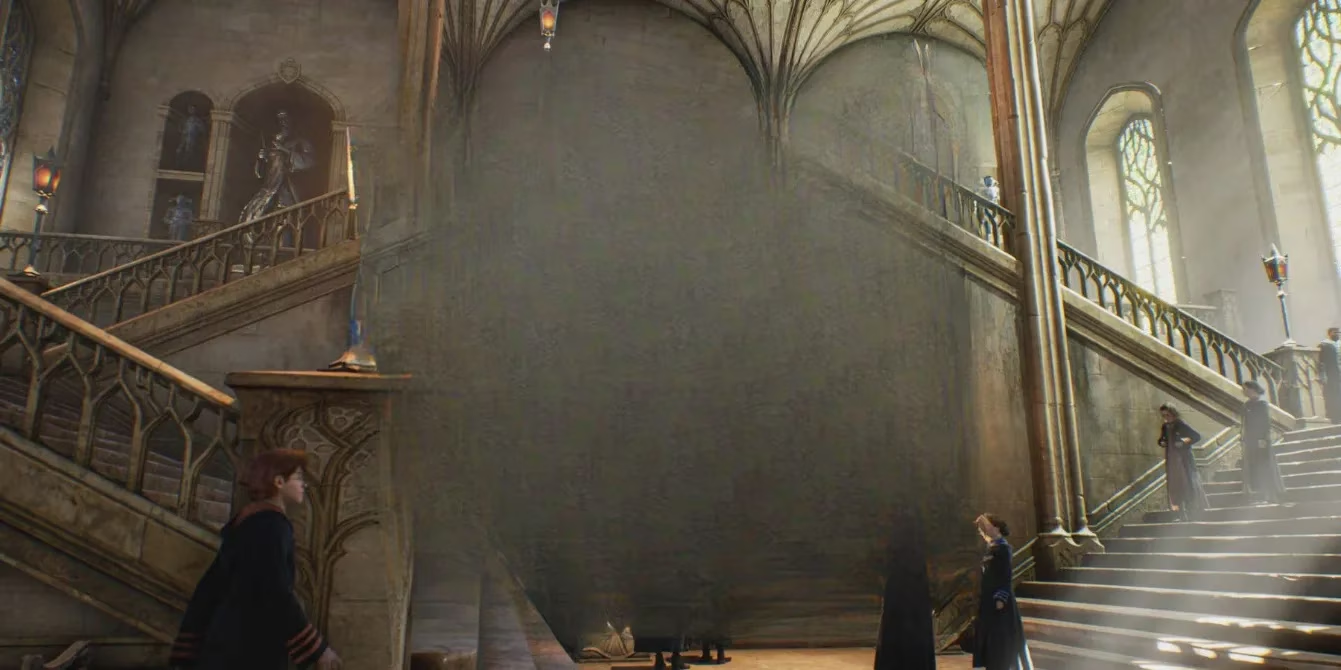
Back in early 2024, J.B. Perrette, the head of games at Warner Bros., stood before a Morgan Stanley audience and essentially declared that single-player console games were yesterday’s Butterbeer. He pointed at Hogwarts Legacy—the very title that outsold every other 2023 release, including the latest Call of Duty and the long-awaited Starfield—and called it a “one-and-done” product, something the company wanted to evolve past. His vision? A persistent online Harry Potter universe where players could “live and work and build and play” indefinitely. The irony was rich: the company had just watched its live-service gamble Suicide Squad get dunked on by critics and players alike for its soul-crushing grind and hollow systems, while Hogwarts Legacy sat pretty on a mountain of cash. But Perrette was undeterred.
Fast-forward to 2026, and the consequences of that strategic pivot are finally starting to bubble up. Hogwarts Legacy 2 has been officially confirmed (because Warner Bros. would need to be Confunded not to make a sequel), but every tidbit of information suggests a strange hybrid approach. Leaked job listings from early 2025 mentioned “seamless co-op integration” and “seasonal narrative events,” which sent the fanbase into a collective panic. Was the sequel about to be infected with battle passes and daily login rewards? Would players be asked to grind for House Points that reset every month? The wizarding world began to sweat.
What makes the whole situation so bewildering is the persistence of the live-service fantasy inside WB Games. In 2025, they quietly launched Harry Potter: Spellbinders, a mobile city-builder where players could construct their own Diagon Alley shops and “collaborate” with other witches and wizards. It was polished, yes, but it attracted less buzz than a snoozing Flobberworm. Yet Perrette’s team seemed to take that as encouragement, not a warning. One internal studio (rumored to be the remnants of Rocksteady, still nursing post-Suicide Squad wounds) is now supposedly working on a Game of Thrones free-to-play MMO, because if one live-service sword cut you, why not try an even bigger sword?
Here’s the question that haunts every pub in Hogsmeade: can Warner Bros. really afford to gamble Hogwarts Legacy 2 on a live-service framework? The first game succeeded precisely because it was a lovingly crafted, single-player escape into a world fans had dreamt about for decades. It didn’t need weekly challenges or a premium currency for house robes. If the sequel forces always-online requirements or gated story progression behind repetitive multiplayer chores, it could alienate the very audience that made the brand a gaming powerhouse. In 2026, the post-Suicide Squad landscape is littered with games that tried to monetize player engagement and ended up monetizing player exit. Even established heavyweights like Helldivers 2 proved that live service can work when it respects players’ time and intelligence—but Warner Bros. has shown no sign of understanding that subtle magic.
The table below neatly captures the contrast between two paths taken by WB Games in recent memory, and it reads like a classic cautionary tale:
| Game | Release | Type | Outcome | Fan Sentiment (2026) |
|---|---|---|---|---|
| Hogwarts Legacy | 2023 | Single-player | Breakout success, 30+ million copies sold | Still beloved, modding community thrives |
| Suicide Squad: Kill the Justice League | 2024 | Live-service looter-shooter | Critical and commercial failure, player count evaporated | Often cited in “how not to do service games” lists |
Now, does this mean Hogwarts Legacy 2 is doomed? Not necessarily. Insiders whisper that the single-player campaign will remain the core, with optional online components that can be entirely ignored. But the fact that live-service elements are being bolted on at all suggests a leadership group that still sees the first game’s success as a lucky Quidditch catch rather than a replicable strategy. And that’s what makes gamers nervous in 2026: you don’t need to be Professor Trelawney to foresee trouble when a company keeps interpreting its biggest win as a problem to be solved.
Perrette’s original question—“how do we develop a game around Hogwarts Legacy that is a live-service?”—might actually have a simple answer: you don’t. Because sometimes the best way to make people live and work and build in a world is to give them a wonderful story, a handcrafted map, and the freedom to explore on their own terms. Anything else risks turning Diagon Alley into a digital shopping mall with a battle pass for wand skins.
As 2026 rolls on, all eyes are on that first real gameplay reveal. Will Hogwarts Legacy 2 cast Lumos on a new standard for single-player epics, or will it stumble into the same pit that swallowed Suicide Squad? If Warner Bros. ends up trying to sell us a “Season of Slytherin” battle pass, well, at least the memes will be legendary.
This assessment draws from CNET - Gaming, where reporting often frames live-service design around practical realities like always-online requirements, content cadence, and the player backlash that follows when monetization eclipses narrative value. In the context of the concerns swirling around a potentially hybrid Hogwarts Legacy 2, that lens is useful: it highlights why bolting seasonal systems onto a story-led RPG can create friction—especially if progression, cosmetics, or co-op features feel engineered for retention metrics rather than for immersion in the Wizarding World.