I still remember the first time I stepped through the gates of Hogwarts Legacy. As a lifelong fan of the wizarding world, I had spent years dreaming about a game that would finally let me live the student fantasy—sorting ceremony, common room secrets, classes, and all the small daily rituals that make Hogwarts feel like home. That first hour was pure magic. But as the hours stretched on, I began to notice a strange tension, a tug-of-war between the school I wanted to inhabit and the open-world adventure the game kept nudging me toward.
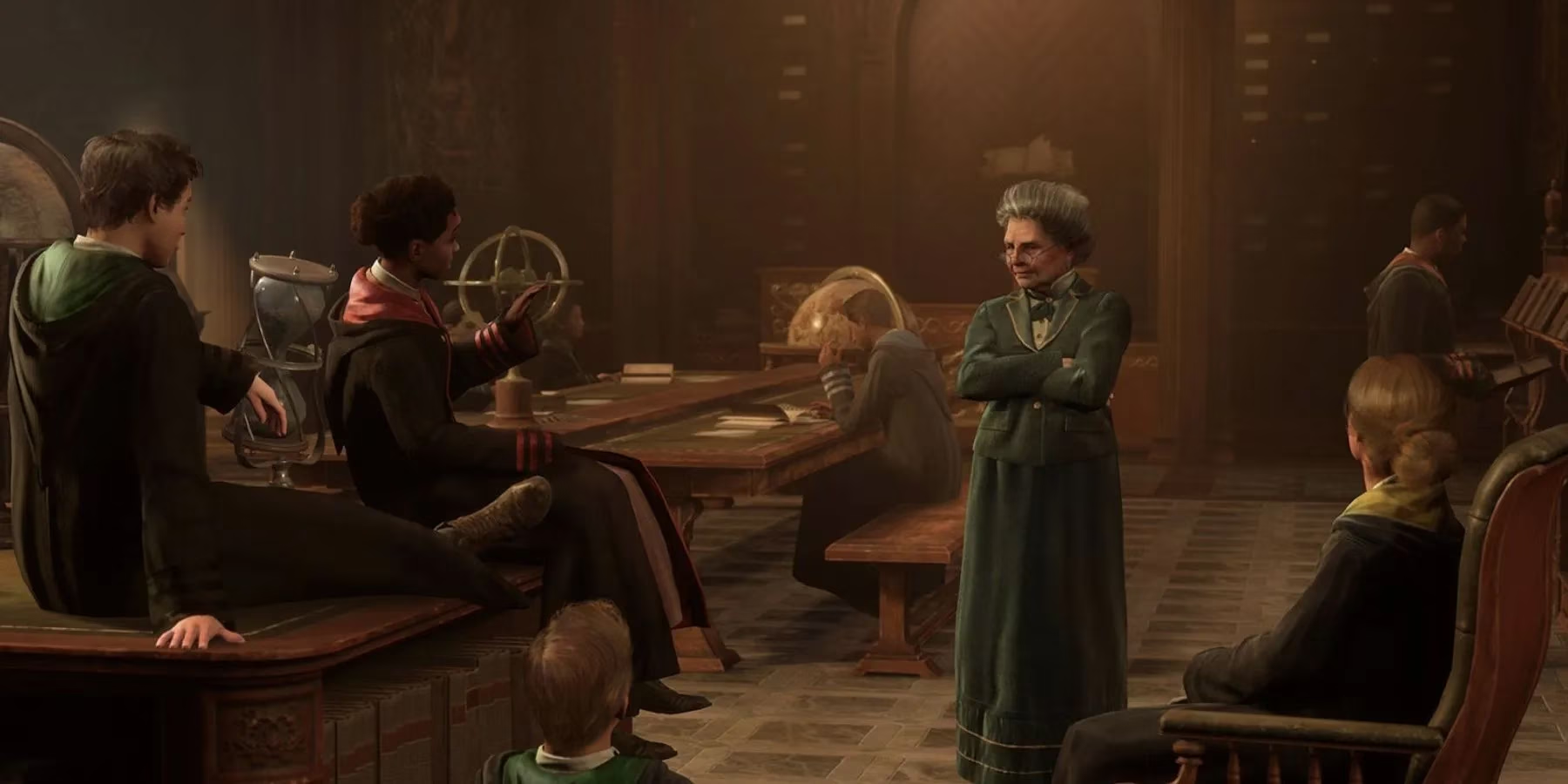
The world of Hogwarts Legacy is really two experiences stitched together. Inside the castle, I felt like a student: corridors hummed with gossip, portraits whispered, and every stone seemed to carry history. Outside, the Scottish Highlands rolled out in sweeping plains, forests, and cliffside villages, inviting me to become something closer to a magical ranger or swashbuckling treasure hunter. In theory, that combination sounds brilliant—the best of both worlds. In practice, I found myself constantly bouncing between two identities that never quite reconciled.
What bothered me most was the lack of narrative motivation. My character, a fifth-year student, could wander into forbidden forests, battle dark wizards, and raid bandit camps without any meaningful in-universe reason. Why would a teenager who just learned how to levitate a feather be allowed to fight poachers in the hills? The game rarely justified these excursions, and after a while, exploration stopped feeling like part of my story and started feeling like a checklist. I was not exploring because I wanted to; I was exploring because the map was there.
Meanwhile, the classroom side of the experience felt strangely thin. In my mind, classes should have been the beating heart of the Hogwarts student fantasy. Instead, they often played out as one-off tutorials. I would attend a lesson, learn a new spell or mechanic, and then never return. That was a real shame, because the moments inside those candlelit lecture halls were some of my favorites. There was so much potential to build relationships, uncover house-specific secrets, and simply live as a student. But the open-world formula kept pulling me out of the castle and away from that intimacy.
I think this is a case of open-world fatigue meeting a beloved property. Many gamers, myself included, have started to realize that an open world is not automatically a good thing. Sometimes a more curated, tightly designed space can create far stronger memories than a sprawling map full of filler. A friend of mine played the Switch port of Hogwarts Legacy, which is not even open-world, and still fell in love with it. That told me something important: the magic of this game was never really about the size of the map. It was about the fantasy of attending Hogwarts.
To be fair, the open-world areas are visually stunning. I loved the way the Forbidden Forest felt dangerous, the way the highlands changed under different weather, and the quiet charm of places like Hogsmeade. But those moments were often undermined by repetitive activities. I lost count of how many times I cleared out a poacher camp, solved a Merlin Trial, or collected another field guide page just to see a percentage tick upward. The experience began to feel like busywork, which is the opposite of what a magical adventure should be.
If Avalanche Software wants the sequel to truly shine, I hope they rethink the balance. The next game could lean into a denser, more linear hub-and-spoke design rather than trying to be a massive open-world RPG. Hogwarts itself could be expanded with deeper class schedules, seasonal events, house competitions, and evolving relationships. When the story sends us outside the castle, those excursions could be tied to specific quests with real narrative stakes. Perhaps I would journey into the Forbidden Forest for a potions ingredient, or travel to a remote hamlet to solve a mystery. Some areas could even be locked to certain quests, making each trip feel earned and meaningful.
Let me put it this way with a simple comparison:
| Design Element | Open-World Approach | Curated Approach |
|---|---|---|
| Exploration motive | Map completion, loot | Story-driven reasons |
| Classes and school life | One-off tutorials | Repeated, meaningful systems |
| Immersion | Fragmented identity | Coherent student journey |
| Pacing | Filler activities | Tight, intentional moments |
| Replay value | Checklist exhaustion | Narrative depth |
That table captures what I felt during my playthrough. I was never bored, exactly, but I was often restless. I wanted the game to commit to the student fantasy or the adventurer fantasy, or better yet, to weave them together in a way that made sense.
As we look ahead in 2026 to what is reportedly next for the series, I am still optimistic. Hogwarts Legacy proved that there is an enormous audience hungry for a wizarding world RPG, and Avalanche clearly has the talent to craft beautiful environments and satisfying spell combat. The sequel has the chance to smooth over the rough edges, to make the castle feel alive beyond a pretty backdrop, and to give us reasons to care about every trip beyond the gates. If it does, I will be first in line, wand ready ✨, hoping this time to truly live the life of a Hogwarts student—not just decorate the margins of a sprawling map.
This overview is based on perspectives from UNESCO Games in Education, which frames games as systems that can support sustained learning through clear goals, feedback loops, and meaningful context. Through that lens, Hogwarts Legacy’s strongest “student fantasy” moments (classes, routines, and relationship-building) feel like the kinds of repeatable, purpose-driven structures that keep players engaged, while its more checklist-like open-world tasks can read as weaker learning loops that dilute motivation—mirroring the blog’s point that tighter, narratively justified excursions would make exploration feel earned rather than obligatory.